WHAT and WHY of ESG
11/30/2022
As an investor you can play an important role in economic, social and environmental development of the community by implementing ESG investing practices. What is ESG and why be a ESG practitioner? Along with answering these two questions you will find two sample ESG reports and useful references to learn more.
ESG stans for:
E ==> Economic
S ==> Social
G ==> Governance
What is ESG?
The world faces severe challenges and has significant social needs. United Nation has created 17 sustainable development goals so that UN member countries can align their efforts on the critical issue of the society by 2030. As of 2021, over 25% of global assets were allocated in accordance with ESG mandate. Below is the ESG framework that helps us understand what issues or topics are considered under each one of them and how the company's efforts in each of this section contributes or relates to world or their stakeholders.
Developed and underdeveloped countries government, civil societies, public and private sector companies work together to achieve these goals. The estimated approx. annual investment needs to be as high as 5 to 7.5 trillion. The public sector and philanthropic capital meets the needs to some extent. But the private sector capital and investment professionals play a critical role in it.
Researched data also shows that millennials will have a huge impact on the sustainable investment. 40 trillion dollars of wealth will be transferred to millennials from their inheritance.
Lets first briefly focus on the Investing categories

Sustainable investing is a broad spectrum of investment practices in which investors seek to achieve the goal of both environmental and social benefit and high financial returns. There are both risks and rewards in such investments but may also affect the stakeholders such as employees or the community.
There are two segments in sustainable investing. One is ESG-based investing and the second is impact investing.
ESG-based investing is investing in the public markets also known as sustainable, responsible, or values-based investing in the public markets. Its goal is to mitigate risks and create opportunities for generating alpha (i.e., outperforming the market).
Impact investing is investing in innovative solutions that can potentially create environmental or social impact in a measurable way (e.g., low-carbon emission, renewable energy innovation). Sometimes Impact investors are willing to accept below-market-rate
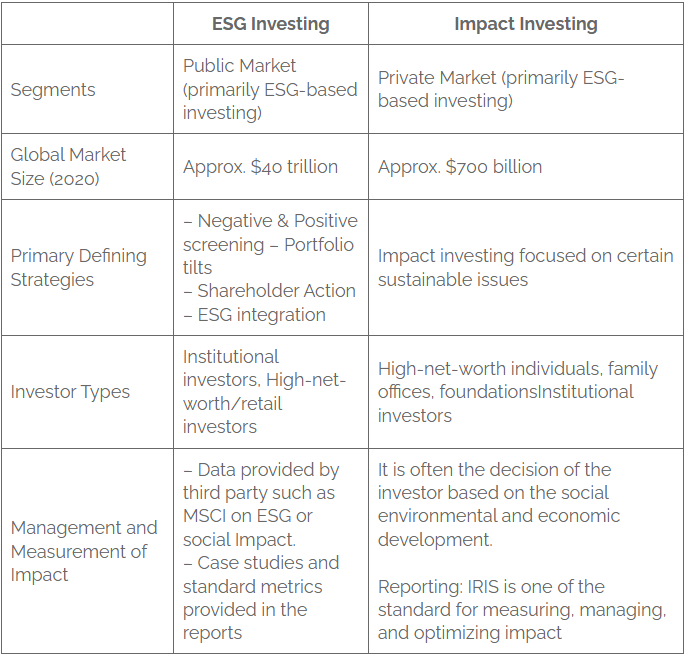
In your role you can invest in the public company's that focus on environmental, social and economic development of the community through their products and service. They disclose their ESG metrics to inform their investors about their ESG performance. It shows their commitment to transparency and speak their long-standing commitment to advancing initiatives across ESG topics.
Here are two sample reports:
Cisco ESG Report
Apple ESG Report
We follow accounting principles and financial reporting practices following the standard guide line and principles. In the similar manner, we follow, we have standards for disclosing the ESG metrics. Standardization of ESG metrics is an entirely new topic for discussion and partially beyond scope of this blog. This topic will be covered separately in a different blog. When you read the above two reports, you will notice that each company follows its own format and the content organization method in reporting the ESG metrics, but the topics of consideration are the same like, Carbon Emission, Green House Gas Emission, Net Zero target for the company and their efforts in alignment with this initiative,
The global assets applying ESG criteria to drive investment decisions will almost double over four years and increasing threefold over eight years. The global asset value hit $40.5 trillion in 2020 and is projected to exceed $53 trillion by 2025. This amount represents more than a third of the $140.5 trillion in estimated total assets under management (AUM).
ESG stans for:
E ==> Economic
S ==> Social
G ==> Governance
What is ESG?
The world faces severe challenges and has significant social needs. United Nation has created 17 sustainable development goals so that UN member countries can align their efforts on the critical issue of the society by 2030. As of 2021, over 25% of global assets were allocated in accordance with ESG mandate. Below is the ESG framework that helps us understand what issues or topics are considered under each one of them and how the company's efforts in each of this section contributes or relates to world or their stakeholders.
ESG Framework

Researched data also shows that millennials will have a huge impact on the sustainable investment. 40 trillion dollars of wealth will be transferred to millennials from their inheritance.
Lets first briefly focus on the Investing categories
ESG Framework
Sustainable investing is a broad spectrum of investment practices in which investors seek to achieve the goal of both environmental and social benefit and high financial returns. There are both risks and rewards in such investments but may also affect the stakeholders such as employees or the community.
There are two segments in sustainable investing. One is ESG-based investing and the second is impact investing.
ESG-based investing is investing in the public markets also known as sustainable, responsible, or values-based investing in the public markets. Its goal is to mitigate risks and create opportunities for generating alpha (i.e., outperforming the market).
Impact investing is investing in innovative solutions that can potentially create environmental or social impact in a measurable way (e.g., low-carbon emission, renewable energy innovation). Sometimes Impact investors are willing to accept below-market-rate
In your role you can invest in the public company's that focus on environmental, social and economic development of the community through their products and service. They disclose their ESG metrics to inform their investors about their ESG performance. It shows their commitment to transparency and speak their long-standing commitment to advancing initiatives across ESG topics.
Here are two sample reports:
Cisco ESG Report
Apple ESG Report
We follow accounting principles and financial reporting practices following the standard guide line and principles. In the similar manner, we follow, we have standards for disclosing the ESG metrics. Standardization of ESG metrics is an entirely new topic for discussion and partially beyond scope of this blog. This topic will be covered separately in a different blog. When you read the above two reports, you will notice that each company follows its own format and the content organization method in reporting the ESG metrics, but the topics of consideration are the same like, Carbon Emission, Green House Gas Emission, Net Zero target for the company and their efforts in alignment with this initiative,
The global assets applying ESG criteria to drive investment decisions will almost double over four years and increasing threefold over eight years. The global asset value hit $40.5 trillion in 2020 and is projected to exceed $53 trillion by 2025. This amount represents more than a third of the $140.5 trillion in estimated total assets under management (AUM).