Reducing Carbon Footprint as an Responsible Investor
02/17/2023
First Thing First:
I'll first talk about what steps investors can take to reduce their carbon footprint assuming you are knowledgeable about the importance of global warming due to entrapment of the Carbon/Greenhouse Gases in the atmosphere.
If you are new to this topic, you can start reading this blog from the last two paragraphs related to further details on Carbon Footprint and its importance and then return to the top.
Reducing you carbon footprint is a responsibility towards yourself, community, and towards the future generations. You have to leave this place better than what it was.
Reducing Carbon Footprint aligns with the 13th Sustainable development Goal of "Climate Change" out of the 17 development Goals of United Nations Organization towards peace, prosperity and wellbeing across the globe. A Paris Agreement was formed to support the mission of the Climate Change. In 2015, 196 Parties met to form the Paris Agreement committed to transforming their development trajectories towards sustainability and called for limiting global warming to well below 2°C - ideally 1.5°C - above pre-industrial levels. To meet these goals, global carbon dioxide emissions need to be reduced by 45 per cent by 2030 from 2010 levels, and reach net-zero emissions by 2050. Greenhouse gas concentrations reached new highs in 2020, with globally averaged mole fractions of CO2 exceeding 410 parts per million
We as an Investor have a very important role to play in the Climate Change Initiative. Here is how we can contribute:
What is Carbon Footprint we are referring to in this blog?
Carbon: When we refer to the world Carbon here, we are referring to greenhouse gages. Gases that trap heat in the atmosphere are called greenhouse gases. These gases are Carbon Dioxide (CO2), Methane (CH4), Nitrogen Dioxide N2O, and Fluorinated gages (Hydrofluorocarbons, per fluorocarbons, sulfur hexafluoride, and nitrogen trifluoride) are synthetic, powerful greenhouse gases that are emitted from a variety of household, commercial, and industrial applications and processes. Fluorinated gases are typically emitted in smaller quantities than other greenhouse gases, but they are potent greenhouse gases. With global warming potentials (GWPs) that typically range from thousands to tens of thousands, they are sometimes referred to as high-GWP gases because, for a given amount of mass, they trap substantially more heat than CO2.
Footprint: Our activities that can lead to produce carbon/greenhouse gases resulting in trapping more heat in the environment.
There is detailed information available on each type of Green House Gases, its sources and elimination strategies. (https://www.epa.gov/ghgemissions/overview-greenhouse-gases)
Why are Green Houses Gases Harmful?
https://www.epa.gov/ghgemissions/overview-greenhouse-gases
Greenhouse gas emissions will continue to increase without critical steps to shift economies towards carbon neutrality
“We have to start moving beyond targets, we have to start moving beyond aspiration, we have to start moving beyond statements of hope, and deliver signs of action.”
- Jacinda Ardern, Prime Minister of New Zealand
I'll first talk about what steps investors can take to reduce their carbon footprint assuming you are knowledgeable about the importance of global warming due to entrapment of the Carbon/Greenhouse Gases in the atmosphere.
If you are new to this topic, you can start reading this blog from the last two paragraphs related to further details on Carbon Footprint and its importance and then return to the top.
Reducing you carbon footprint is a responsibility towards yourself, community, and towards the future generations. You have to leave this place better than what it was.
Reducing Carbon Footprint aligns with the 13th Sustainable development Goal of "Climate Change" out of the 17 development Goals of United Nations Organization towards peace, prosperity and wellbeing across the globe. A Paris Agreement was formed to support the mission of the Climate Change. In 2015, 196 Parties met to form the Paris Agreement committed to transforming their development trajectories towards sustainability and called for limiting global warming to well below 2°C - ideally 1.5°C - above pre-industrial levels. To meet these goals, global carbon dioxide emissions need to be reduced by 45 per cent by 2030 from 2010 levels, and reach net-zero emissions by 2050. Greenhouse gas concentrations reached new highs in 2020, with globally averaged mole fractions of CO2 exceeding 410 parts per million
Climate Change - Take urgent action to combat climate change and its impacts is one of the very important Goal formed by United Nations Organization for us to take steps as responsible citizens of this world.
We as an Investor have a very important role to play in the Climate Change Initiative. Here is how we can contribute:
- Value Aligned Investment Portfolio: Positive/Negative Screening of the companies and creating a portfolio tilts to support the companies that align their products and services with ESG (Environmental, Social and Governance ) strategy for long term sustainability.
- ESG Integration and Engagement Strategy for creating a Green Alpha: Some investors aim to outperform the market by identifying companies with great performance on material ESG issues, with the expectation that these companies will outperform their industry peers over the long term. Further, these investors may also identify companies underperforming on material ESG issues and engage with their management to create value by improving their ESG performance.
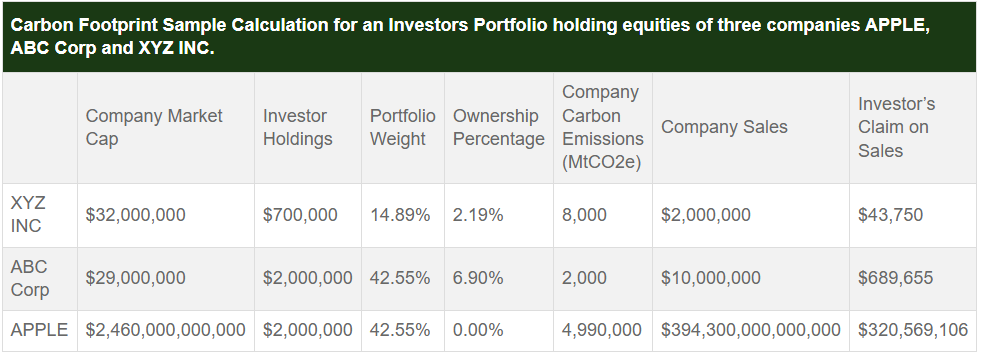
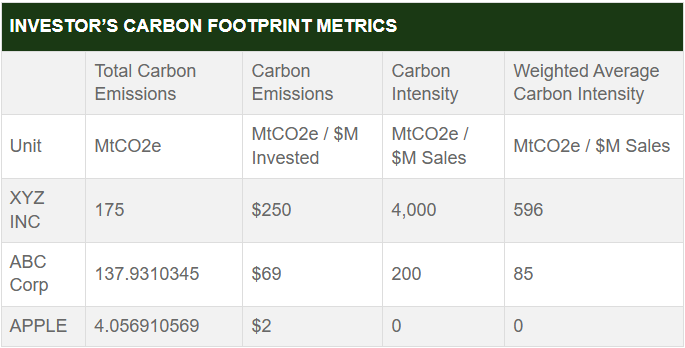
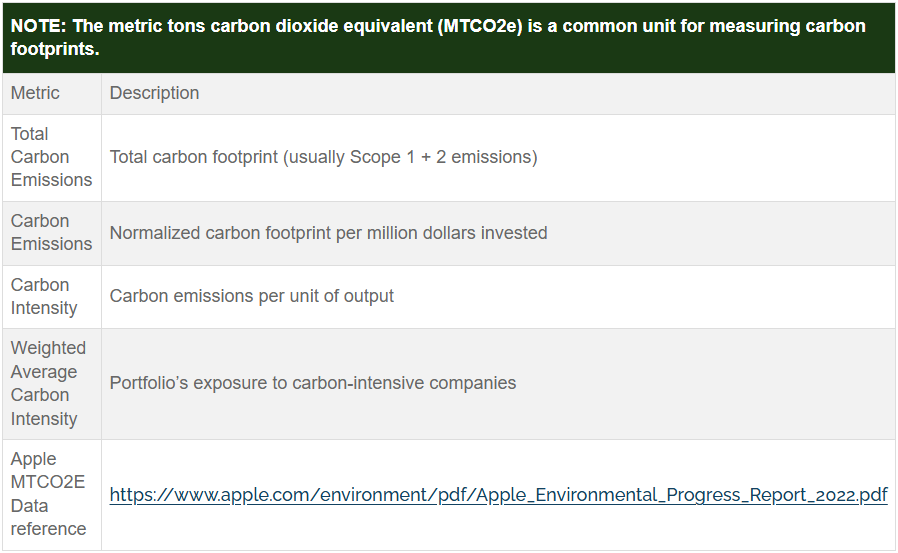
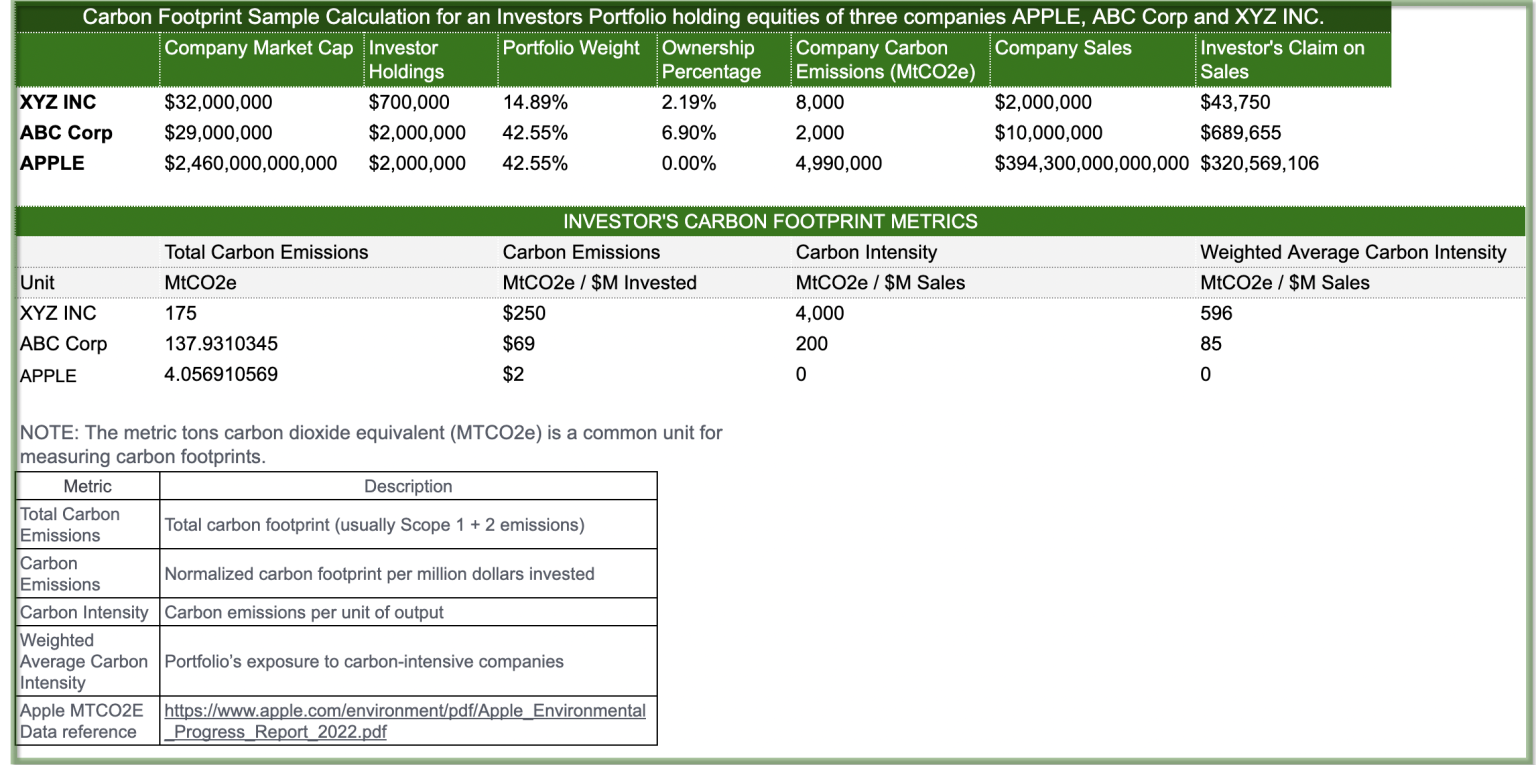
- Creating a Portfolio that is Carbon resilient: We look at the level of carbon emitted by the company we invest in. We look our investment proportion in comparison to overall market value of that company. We take into consideration the amount of carbon emitted in proportion to our investment, the industry standard carbon tax rate, and determine carbon tax for our portfolio.
What is Carbon Footprint we are referring to in this blog?
Carbon: When we refer to the world Carbon here, we are referring to greenhouse gages. Gases that trap heat in the atmosphere are called greenhouse gases. These gases are Carbon Dioxide (CO2), Methane (CH4), Nitrogen Dioxide N2O, and Fluorinated gages (Hydrofluorocarbons, per fluorocarbons, sulfur hexafluoride, and nitrogen trifluoride) are synthetic, powerful greenhouse gases that are emitted from a variety of household, commercial, and industrial applications and processes. Fluorinated gases are typically emitted in smaller quantities than other greenhouse gases, but they are potent greenhouse gases. With global warming potentials (GWPs) that typically range from thousands to tens of thousands, they are sometimes referred to as high-GWP gases because, for a given amount of mass, they trap substantially more heat than CO2.
Footprint: Our activities that can lead to produce carbon/greenhouse gases resulting in trapping more heat in the environment.
There is detailed information available on each type of Green House Gases, its sources and elimination strategies. (https://www.epa.gov/ghgemissions/overview-greenhouse-gases)
Why are Green Houses Gases Harmful?
https://www.epa.gov/ghgemissions/overview-greenhouse-gases
Take urgent action to combat climate change and its impacts
Problem we face today:Greenhouse gas emissions will continue to increase without critical steps to shift economies towards carbon neutrality
“We have to start moving beyond targets, we have to start moving beyond aspiration, we have to start moving beyond statements of hope, and deliver signs of action.”
- Jacinda Ardern, Prime Minister of New Zealand